Understanding Ourselves: The Anglican Faith

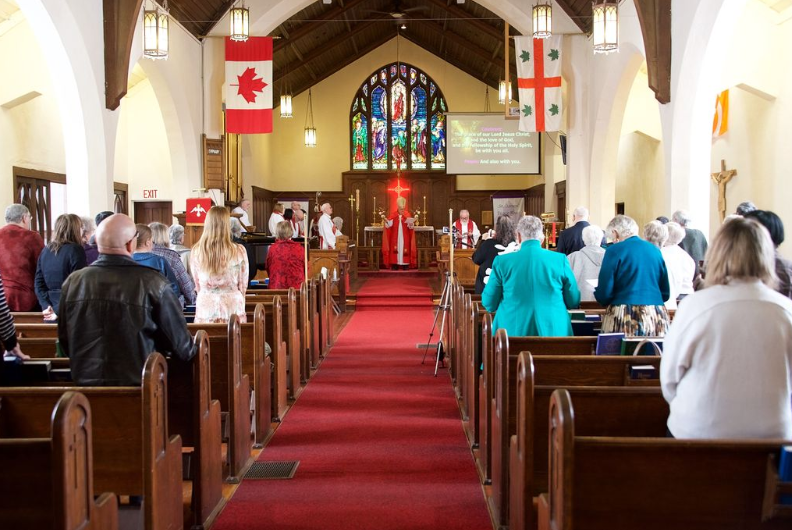
Why are our worship centres built the way they are?
When you walk in the front door of an Anglican church worship centre, anywhere in the world, you will probably see rows of benches or chairs facing the far end, with a central aisle going up it. Near the far end, some benches may face towards each other across the central aisle. At the far end, there will be a railing, and behind that and raised up a step or two, a rectangular piece of furniture (like a tall table) covered with cloth. Behind that on the wall there is usually a large cross. As well, there are often windows, often filled with coloured (or ‘stained’) glass figures.
Are they all like that?
Not all are like that, but that is the traditional arrangement for most Anglican worship centres. It is very intentional.
Why?
The hope is that the architecture itself and the arrangement of the furniture will draw you towards God.
God is in the furniture?
Well, no. The central aisle, and the direction almost everyone sits, focuses on one end, where the altar (that large piece of furniture) sits. Over the altar is the cross. Everyone’s focus is therefore to be on the altar and the cross. The altar is the place of sacrifice – in this case, our sacrifices, and the sacrifice of Jesus. The cross is also the place of the sacrifice of Jesus. We join our sacrifices with those of Christ Jesus for His people, to be, more and more, one with Him.
The architecture and the furniture are all trying to draw you physically in, to being part of the Great Story of God, starting at the point of Jesus’ sacrifice for us. This sacrifice is the most important thing of all. The furniture and architecture of our worship spaces try to bring the incarnational reality of our God into your life.
When you enter church for worship this week, let your eye follow the lines of the building and furniture. Focus on the altar, then the other items. Take note of what you see, assigning an order of importance as indicated purely by the architecture and furniture placement. What does this say about our worship? For example, a reading stand maybe prominent – this indicates the importance to us of having scripture read. A musical instrument (typically an organ or piano) may also be prominent – this indicates the importance of music in our worship services. What other items can you find?
+David