Understanding Ourselves: The Anglican Faith

What about Shalom?
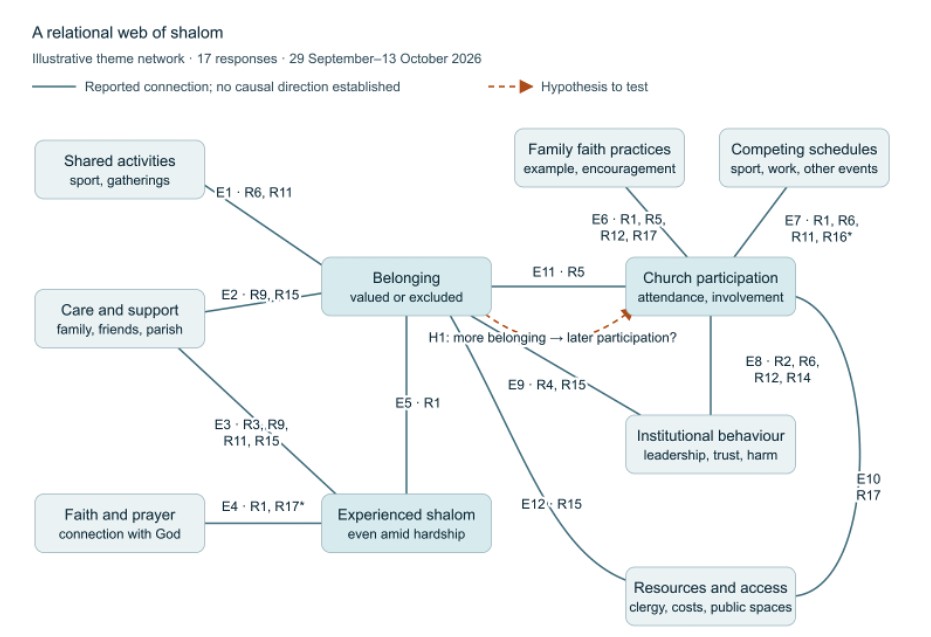
I recently, via email to the Synod Delegates and a request in last week’s email update, asked people to fill in a survey on ’shalom’. I’d like to thank the 17 people who did so!
Looking at the responses, the above map was created.
The responses are fascinating. Respondents repeatedly connect faith, supportive relationships, and a sense of belonging and being valued with experienced wholeness, including during loss or bereavement. This suggests that caring relationships and meaningful belonging are important contributors to shalom, alongside material security, health, justice, and other dimensions of life. The survey accounts also suggest that experienced wholeness can coexist with suffering and grief. Being cared for, valued, and able to belong emerges as a central theme in these accounts of wholeness.
As we love others in Christ, we seek to extend that same care and welcome, listening to how they experience their lives and what belonging means to them.
Jesus repeatedly brought healing and health to people, even while He differentiated between ‘earthly’ health and ‘heavenly’ health. For example, before healing the paralyzed man, He first forgave him his sins. After healing ten lepers, he highlighted that gratitude and faith (as shown by the one who returned) were central to true wholeness. He warned against placing trust in earthly riches or health, which are transient, and urged us to pursue true health for eternity. True healing was not only physical but also involved spiritual, relational, and emotional wholeness (Luke 7:50, 8:48) with faith in Him.
So, what does shalom mean in practical terms? First, I think it means we have what we need to live: “Give us this day our daily bread.” Second, I think it means we know we are cared for and belong. We are forgiven, we forgive others, we do not open ourselves up to temptation (by comparing ourselves to others for example), and we discourage harm and hurt, and encourage blessing and help. Pursue health and wellness, not sickness and unsoundness. For ourselves, for others around us, and for God.
In other words, Shalom can be thought of as, “Love God with all you are, and love your neighbour as you love yourself.”
Shalom is the peace and wholeness we seek in relationship with God, one another, and creation. As Christians, we participate in that work by loving God with all we are and loving our neighbours as ourselves—through care, forgiveness, justice, practical provision, and faithful companionship, including when suffering remains.
Who knew?
+David