Understanding Ourselves: The Anglican Faith

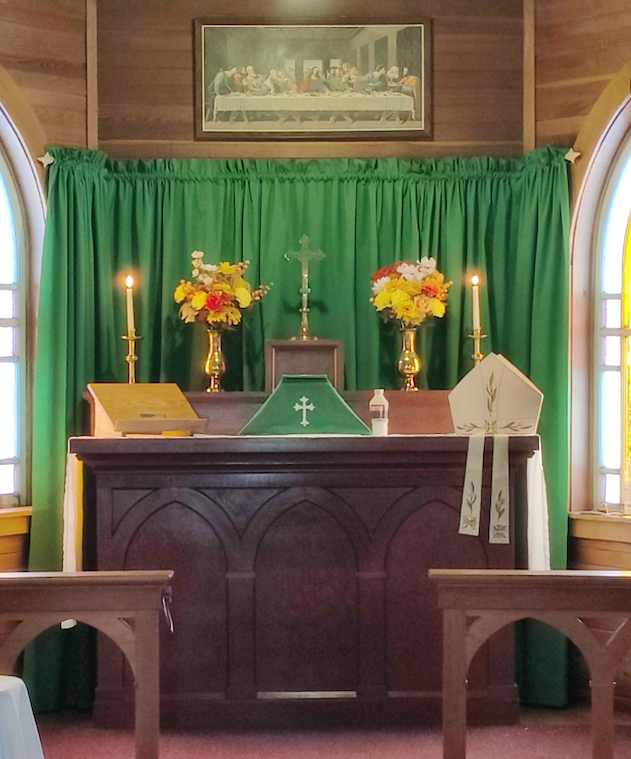
Why is the altar at one end of the building?
In our diocese, all of our worship centres have an altar at one end, usually the far end from the entrance. Why?
First of all, the altar is set at one end as a focal point for all who attend worship. The focus of the entire assembly is on joyful gratitude for Christ offering Himself for us, and the altar is where the sacrifice of Christ, His body and blood, are placed each Sunday that we celebrate Holy Communion. The focus for the priest and all the people is on Christ, not on anyone else. Our worship is directed to God, not to one another. Therefore, the pews or chairs are arranged not to look at each other, but to look at the altar. The exception to this would be choir stalls, where choir members look centrally so their voices of praise, adoration, and worship can be heard better to help lead the congregation in worship.
Regardless of its actual orientation, the altar placement is always to the “liturgical east.” Why east?
First, east is where the sun rises — and the sun rising is a metaphor for the son rising. As it says in Matthew, “For just like the lightning comes from the east and flashes to the west, so the coming of the Son of Man will be” (Matthew 24:27). The east therefore symbolized the second coming of Christ and our resurrection.
This was echoed in early baptism practices, as noted by Cyril of Jerusalem (A.D. 315-386), the catechumen (student candidate) faced west to renunciate Satan, his works and his ways, because the west symbolized the region of darkness (being that’s where the sun set). The candidate then turned to face east, from whence the sun rises, to profess faith in Christ, the Light of the World, and allegiance to the Father, Son, and Holy Spirit.
From the earliest times of Christianity therefore believers would face east to pray, and so it made sense for the altars to be placed in the east. Where this was physically difficult, the altar was placed where practical, but this was always thought of as “east” inside the building (regardless of its actual orientation) — hence the term “liturgical east.”
In this way, we align our physical orientation as believers with our inner commitment to Christ and our understanding of blessed eternal life with Him in the eternal church.
+David